Is There Another Me in Another Dimension Art Lesson
Last Updated on May 27, 2021
This article contains everything an Art student needs to know about cartoon in i point perspective. Information technology includes step-by-step tutorials, lesson plans, handouts, videos and costless downloadable worksheets. The material is suitable for middle and loftier schoolhouse students, too as whatsoever other person who wishes to learn how to draw using single point perspective. Information technology is written for those with no prior experience with perspective, beginning with basic concepts, earlier working towards more than complex iii-dimensional forms.

I signal perspective: definition
Dictionary.com define 1 point perspective as:
…a mathematical system for representing iii-dimensional objects and space on a two-dimensional surface by ways of intersecting lines that are drawn vertically and horizontally and that radiate from one bespeak on a horizon line…
Although this definition sounds complicated, the concept is relatively uncomplicated. Ane point perspective is a drawing method that shows how things appear to get smaller as they get further away, converging towards a unmarried 'vanishing point' on the horizon line. It is a way of drawing objects upon a apartment slice of newspaper (or other drawing surface) and then that they await three-dimensional and realistic.
Drawing in one point perspective is usually appropriate when the subject is viewed 'forepart-on' (such as when looking directly at the face up of a cube or the wall of building) or when looking directly down something long, like a road or railway track. It is popular drawing method with architects and illustrators, especially when drawing room interiors. To empathise more than well-nigh the history of perspective in art, please read our accompanying Guide to Linear Perspective (coming presently).
Annotation: If you need to draw something that is not facing you directly, but rather has a corner nearest to you, two betoken perspective is likely to be more than appropriate.
Rules of perspective: true shapes, vanishing points and horizon lines
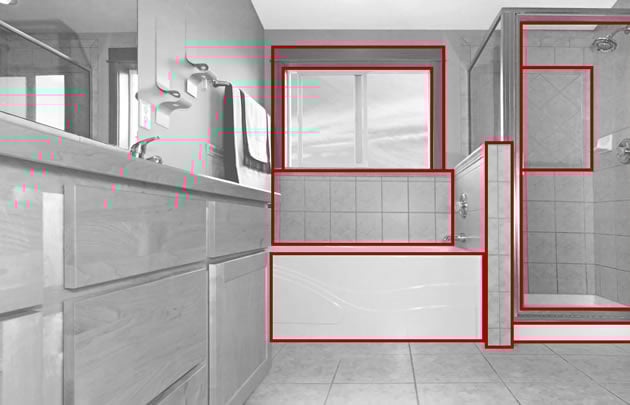
In one point perspective, surfaces that confront the viewer appear equally their true shape, without any distortion. They are drawn using primarily horizontal and vertical lines, as illustrated by the diagram beneath:
Surfaces that travel away from the viewer, on the other hand, converge towards a single 'vanishing indicate'. This is a betoken that is located directly in front of the viewer'due south eyes, on a 'horizon line' (also known equally an 'centre level line'), equally illustrated in the photograph below:

Information technology is possible to draw over photographs to identify vanishing points, horizon lines and truthful shapes. Studying the piece of work of famous artists can also aid y'all proceeds an agreement of one point perspective, equally shown in the case by Vincent van Gogh below.
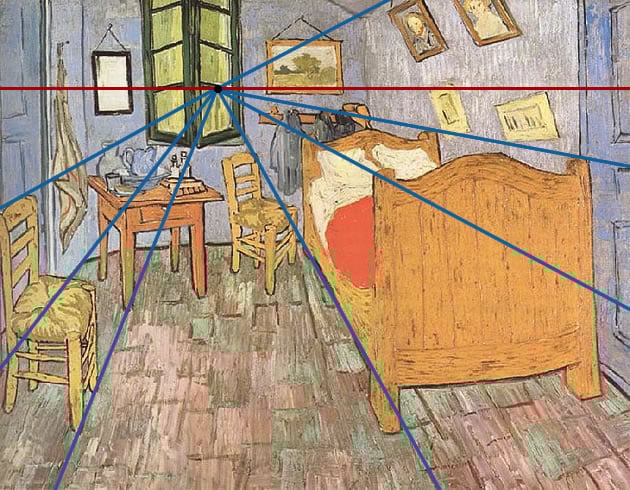
Cardinal Points:
- Surfaces that face up the viewer are drawn using their true shape
- Surfaces that travel away from the viewer converge towards a single vanishing point
Ane point perspective tutorial
The post-obit tutorial explains how to draw one point perspective step-by-step. The exercises are designed to be completed in the order given, with each ane building upon the previous chore. All worksheets are available as a complimentaryperspective drawing PDF that tin can be printed at A4 size (more worksheets will be added to this over fourth dimension).
The downloadable PDF has been provided by the Student Art Guide for classroom use and may be issued freely to students (credited to studentguide.com), every bit well every bit shared via the social media buttons at the bottom of this page. The worksheets may not exist published online or shared or distributed in whatsoever other mode, as per our terms and conditions.
Recommended Equipment:
- Mechanical or 'clutch' pencil (with an HB or 2H lead)
- Blank paper and/or the printed worksheets
A ruler and compass can exist useful while learning to describe in one point perspective, still most Art students observe that these exercises are best completed freehand, with dimensions and proportions gauged by eye. This is so that the skills are easily transferrable to an observational drawing.
EXERCISE 1: CUBES AND RECTANGULAR BLOCKS
Drawing rectangular blocks is often the first one point perspective lesson given to students. It is a simple practise that provides a solid foundation for things to come.

This worksheet explains how to draw a cube in one point perspective and takes yous through drawing these above, below and in line with the horizon line. It introduces the importance of line weights and highlights the effect of positioning objects in relation to the horizon line.
By the completion of this exercise, y'all should be able to:
- Use appropriate line weights (low-cal lines for structure lines; dark lines for outlines)
- Position a vanishing point and horizon line correctly
- Understand that:
- Objects above the horizon line are drawn as if y'all are looking up at them (yous see the bottom of the object)
- Objects below the horizon line are drawn every bit if you lot are looking down at them (you lot see the superlative of the object)
- Objects that are neither above nor beneath the horizon line are drawn as if you lot are looking direct at them (you come across neither the top or the lesser of the object)
This information is demonstrated in the video tutorial below:
Practice 2: stacking, holes and angles

This worksheet illustrates how to stack blocks, cut abroad portions and add unusual angles in a one point perspective cartoon, creating gradually more complex forms.
By the completion of this exercise, you lot should exist able to:
- Draw stacked blocks of different sizes
- Draw blocks that have holes cut out of them, projecting construction lines to detect the dorsum edge of the cut surface area
- Slice pieces off blocks and/or add unusual angles
Once you feel confident with drawing these items, you may wish to add more challenging forms, such as letters and/or triangular shaped prisms.
The post-obit video helps to explicate how to draw one point perspective drawing step-by-pace:
An creative person case of perspective by Robert C. Jackson:

Exercise 3: perspective cake letters
Drawing block lettering in i signal perspective is a relatively straight-forward task, suitable for a homework activity.
The following video demonstrates how to practise this:
Exercise 4: finding centres and equal spaces
This video explains how to as divide items in one point perspective, allowing you lot to describe argue posts, lamp posts, and equally spaced windows or buildings.
By the completion of this practice, y'all should be able to:
- Find the centre of any rectangular surface using the 'corner to corner' method (this works even on surfaces that are receding towards the vanishing point)
- Divide the surface of any rectangular block into any number of equal parts
- Describe tiles on a floor in one bespeak perspective
- Draw repeating elements, such as fence posts, receding into the distance
This is explained in the post-obit video tutorial:
Exercise v: i bespeak perspective cityscape
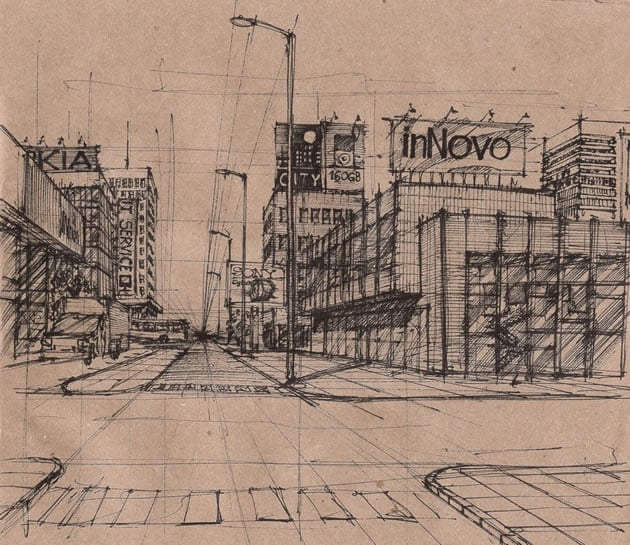
Drawing a road and surrounding cityscape (either imagined or observed from real life) is a great follow-up activeness to the previous exercises. A 1 point perspective street scene typically combines repetitive manmade elements with stacked, cut and athwart forms. This exercise can exist as challenging or minimal every bit desired, allowing able students to move ahead and produce detailed, elaborate drawings.
1 betoken perspective city scene past Lichtgestalt00:

A suburban scene by Karina Barabanova:

A one point perspective painting by Gustave Caillebotte:

A sketch by Daniyar:
Exercise 6: circles and curves
The most challenging aspect of perspective is drawing curving or circular forms. These are typically sketched freehand, inside squares or rectangles to assist get proportions correct.
Fundamental points:
- Use the technique of 'crating' – drawing complex forms within rectangular boxes
- Utilise straight lines (guidelines) to aid the drawing of irregular curves, such as the curving forms of rivers or trees in a i bespeak perspective mural
- Understand that:
- Circles or curving forms that face up the viewer are fatigued using their true shape
- Circles that recede towards the vanishing point appear distorted, appearing smaller as they go further away
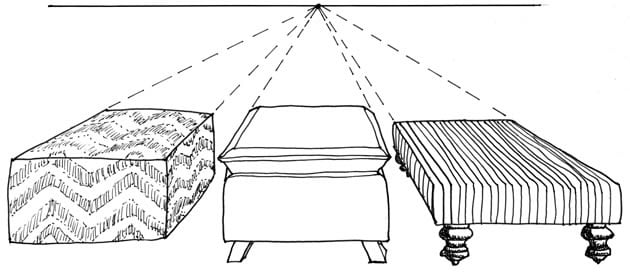
A one point perspective cartoon by Stephanie Sipp, a professor at Florida State College of Jacksonville, Interior Design department:
A perspective landscape by Vincent van Gogh:

A cartoon past high school student Estherlicious:

Exercise seven: one point perspective room
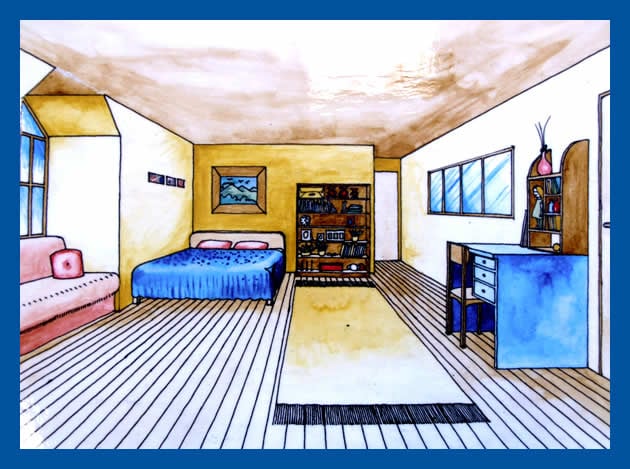
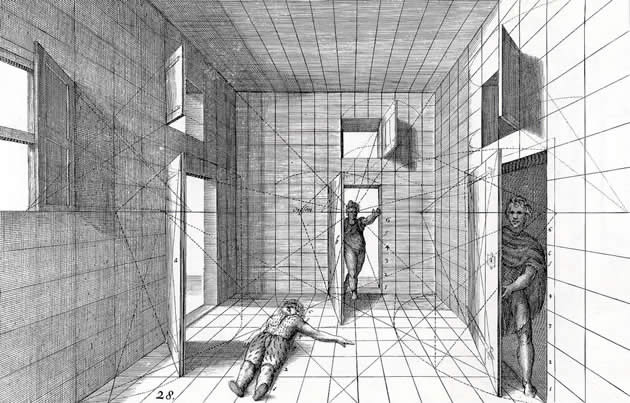
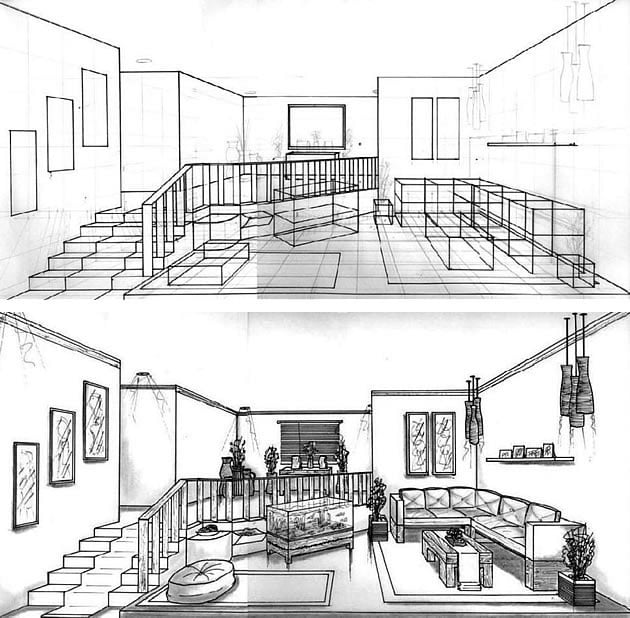
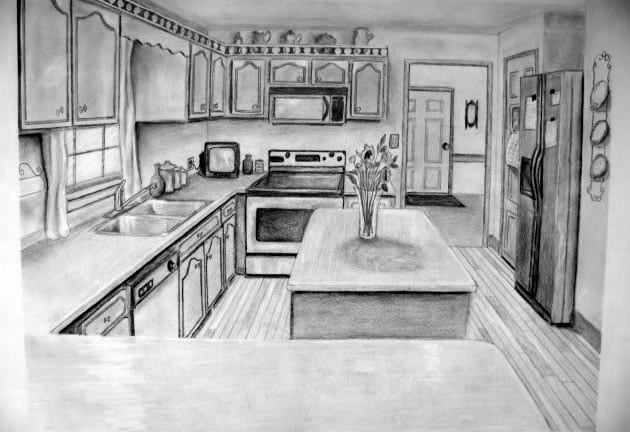
The most common perspective drawing lesson is a ane betoken perspective room. Interiors combine a multitude of skills and can be made as challenging or involved as required. Perspective floor allows you lot to practise dividing surfaces into equal spaces, while the questions of how to draw a window in perspective; furniture / desks / beds; or adjoining corridors etc provide a claiming regardless of your ability level. To gain ideas about how you might approach drawing interiors in perspective, we have included a range of examples beneath, including bedrooms, living rooms, kitchens and hallways. Drawing a room in 1 point perspective can be neat practise for those who wish to afterward pursue interior design, architecture or for those who are studying Design Technology at high school.

The illustration in a higher place shows a one point perspective grid (this may exist downloaded and printed for classroom use) which may be drawn on directly or traced over, using a lightbox.
To understand how to draw a room in one indicate perspective, please view our footstep-past-step video:
Please annotation that this video is not captioned, as it is hoped that the challenging aspects of this exercise are explained earlier in this guide.
A one indicate perspective room by Dutch renaissance architect, painter and engineer, Jans Vredeman de Vries:
A ane point perspective interior by Amani Cagatin:
A one point perspective sleeping accommodation by Cheryl Teh Veen Chea of 1 Academy:

A one point perspective kitchen by Dana Bailey:
A one betoken perspective hallway by Jake Mutch, completed while studying Fundamental Arts at Holland College:
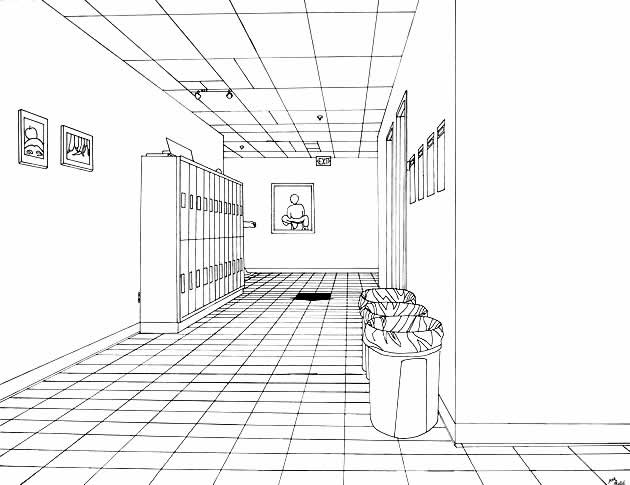
A perspective interior by Southward.Kim:
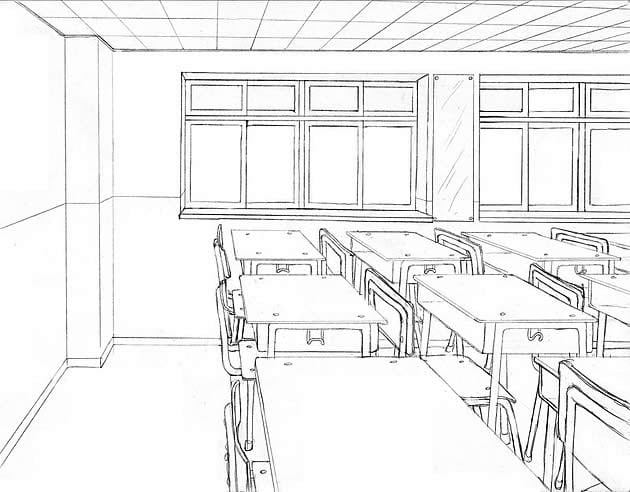
A drawing by Abby Hope Skinner, whose Top in the World A Level Art project has as well featured on the Student Art Guide:

This guide is part of our Essential Lessons for Art Students (a serial of articles packed with downloadable instruction resources) such equally our guide to line drawing. This is a work in progress and will be added to over time!

Amiria has been an Art & Pattern teacher and a Curriculum Co-ordinator for 7 years, responsible for the course design and assessment of student work in 2 loftier-achieving Auckland schools. She has a Bachelor of Architectural Studies, Bachelor of Architecture (First Course Honours) and a Graduate Diploma of Teaching. Amiria is a CIE Accredited Art & Blueprint Coursework Assessor.
Source: https://www.studentartguide.com/articles/one-point-perspective-drawing
0 Response to "Is There Another Me in Another Dimension Art Lesson"
Post a Comment