Hoe Exactly Would You Describe Demographics Asp Art of a Healthcare System?
Creating a diverse and inclusive workforce has been a major initiative for many companies over the last few years and substantial resources have been spent on diversity initiatives. Yet, only 23% of Hr professionals believe their D&I programs are highly effective.
Overall, at that place seems to be a mismatch in how organizations pattern their multifariousness policies and how they implement them in the workplace. This might be the upshot of a number of barriers that can make increasing multifariousness difficult.
Knowing how to measure the success of a diversity or inclusion plan is also a challenge. How do you know when your workforce is diverse or inclusive plenty?
Moreover, without proper tools in place for measuring how inclusive or how diverse your workforce is, it can be challenging to evaluate the potential impact of such initiatives to decide if they're worth the effort.
Near $8 billion a twelvemonth is spent on variety trainings in the United States alone.
-McKinsey & Company
Because diversity has then many different dimensions (including age, gender, race, and more), it'south difficult to know exactly what to measure — and the aforementioned goes with inclusion.
Then, how can you measure diverseness and inclusion initiatives in your organisation? Let'south accept a expect.
What's in?
Which dimensions of diversity and inclusion can yous measure?
Before nosotros swoop into diversity and inclusion metrics to keep an eye on, let's discuss the difference betwixt the 2.
Diversity can be defined every bit the traits or characteristics of an private. Inclusion is the behaviors that ensure the squad feels welcomed. This is where things can get catchy.
For the most role, variety is easy to identify. But inclusion is invisible — knowing whether or not your team feels included and welcome at the company will crave a bit more excavation.
However, there are a few ways you can measure both variety and inclusion to get a amend agreement of your workforce.
There are various dimensions of diversity that you tin can measure.
- Primary, which includes basic characteristics similar age (generational diversity), race, gender, and sexual orientation;
- Secondary, including didactics, marital and parental status, and religious behavior;
- Workplace, including the individual'southward job level, work shift, and years with the organization;
- Mode, including piece of work habits, leadership fashion, and communication style.

Some of these dimensions are piece of cake to attach a number to. Others are a little harder to access. However, information technology is still possible — and of import — to do and then.
Non only do diverse and inclusive teams mean 19% greater employee memory, but employees and job candidates say a diverse workforce is important when evaluating a company and job offer.
How can you lot measure diversity and inclusion?
Now that you better understand what a diverse and inclusive workforce looks similar, here are some metrics you can measure to run into how your organization stacks up.
one. Diversity of employees vs. application puddle
1 of the best means to see if you're hiring plenty various individuals is to take a look at who is applying to your open up positions versus who yous're actually hiring.
If your team is lacking multifariousness but you find that your applicants are extremely diverse, this might be an indication that there is bias in recruitment your procedure. In an platonic world, the diversity of your squad will exist reflective of the diversity of your applicant pool.
To increment diversity in employees relative to the multifariousness of applicants, runway how this number changes every bit you hire more than individuals. Await for opportunities to eliminate bias in your hiring process and implement new initiatives to reach qualified, diverse employees, to improve the quality of candidates when hiring.
Our D&I software can assistance with both assessing your electric current practices and mitigating unconscious bias from the hiring process to build more than inclusive and diverse teams. If you'd like to see what information technology can exercise for your organization, book a demo below.
2. Diversity across organization levels
Look at variety and inclusion across your leadership levels. Is your entry level team extremely diverse, but your leadership does not reflect that?
While your overall team might exist diverse, yous desire the various levels inside your organization to reverberate the diversity of your team. If this is the case, y'all demand to meliorate multifariousness initiatives in how you lot promote within your organisation.
Look at diverse demographics when measuring diversity at leadership. For example, measuring diversity every bit a whole is of import, but it'southward just as important to look at the percentage of women in leadership and percentage of minorities in leadership independently.
It is possible to exist inclusive of ane demographic while nonetheless having bias about other groups. Create initiatives to increase diversity across all areas and levels of your organization.
For example, KPMG NL, one of our clients, set out to digitally transform their hiring procedure to ensure they are in line with the company values and beliefs, and promote diversity and inclusion amongst job applicants.
The Professional Services and Consulting industry in which KPMG NL operates, has traditionally been a male person-dominated field with every bit many equally 66% of new hires identifying as male. This was non an authentic representation of KPMG's belief in a company culture that strives for equality and embraces, respects and values differences of all people.

"Inclusive work cultures that embrace ethical behavior position themselves for success."
— JOLANDA VAN SCHAIK
DIRECTOR INCLUSION & DIVERSITY, KPMG
By partnering with Harver and implementing our D&I solution – including a series of custom pre-employment assessments – they transformed their recruitment process, achieving +47% in female applicants and +44% in female hires.
You can read the KPMG success story beneath.
3. Job satisfaction
Satisfaction with one'due south position is a good way to measure inclusion. Although job satisfaction and inclusion are not ever directly linked, you lot tin measure out specific subject area areas that help you ameliorate understand if employees experience welcomed at their task.
Happiness, inter-team relationships, and recognition can all be measured through surveys to help understand how employees feel most their teams and their task. If they feel happy with their chore, they might also feel more included at piece of work.
Nevertheless, exist sure to look at each specific subject field for deeper insights. If team members are content with their task responsibilities but are defective relationships with other employees, it could be a sign they don't feel included.
If this is the case, y'all'll want to innovate more inclusivity initiatives to bring the team together.
four. Job retention
Job retention and job satisfaction can get hand in hand, but measuring retention is a qualitative way to measure inclusion.
If you have high employee turnover, this might be a sign that employees are unhappy or unfulfilled with their job. This could also indicate that team members are leaving because they don't feel included.
In addition to looking at your overall task memory, examine who is leaving and who is staying. If you find that the bulk of your various hires are leaving, yous might have an inclusivity problem. This might signal dorsum to an issue with job satisfaction, or more senior various employees might exist leaving if they don't meet promotion opportunities available to them.

How to choose your D&I metrics
There is no standard or universal fix of metrics to measure variety and inclusion. Each visitor should take a personalized approach to make up one's mind which metrics they want to measure.
When choosing your D&I metrics, one identify to showtime is with your company goals. Are you lot hoping to increase diversity in leadership? Do y'all desire to make your existing team feel more included and satisfied in their roles? While all of these goals may sound overnice, focus your efforts on just a few goals at a fourth dimension.
Y'all'll also want to consider the size of your organization and how that can bear on D&I, especially when hiring. If yous merely hire for ane position at a time, it can exist difficult to ensure the pct of diverse individuals hired is reflective of the entire applicant pool.
In larger organizations that hire in high volumes, it tin can be easier to implement diversity initiatives at each circular of hiring.
Nonetheless, regardless of your size, y'all desire to be conscious of who you are bringing onto your team. Smaller organizations might accept more time to create diverse teams, but it is still crucial to eliminate bias during the hiring procedure to hire the all-time person for the job — regardless of who they are.
Yous'll as well want to think most how the diversity dimensions you choose to runway volition translate into metrics that can help you move the business concern forward.
For instance, just tracking the age of individuals hired won't tell you much about your workforce. Instead, yous demand to retrieve nigh why historic period is important to edifice a various workforce and what benefits you can receive from hiring individuals from different age groups.
Nosotros've detailed the topic of diversity in recruiting in more depth in our east-book below.
Tools to measure D&I implementation
If y'all desire to truly know where you stand with D&I, you need to implement some tools and technologies to ensure y'all're reading the right metrics.
Pre-employment assessment tools
To remove bias from the hiring process, y'all want to use a practice chosen blind hiring during the pre-pick procedure. Blindly assessing employees before an interview tin ensure the most qualified individuals are moving forwards in the hiring process.
Pre-employment assessment tools can analyze things like skills, qualities, and personality traits that may contribute to a better chore fit. For case, when hiring for contact center positions, you can use a chat assessment tool that offers candidates a realistic job preview.
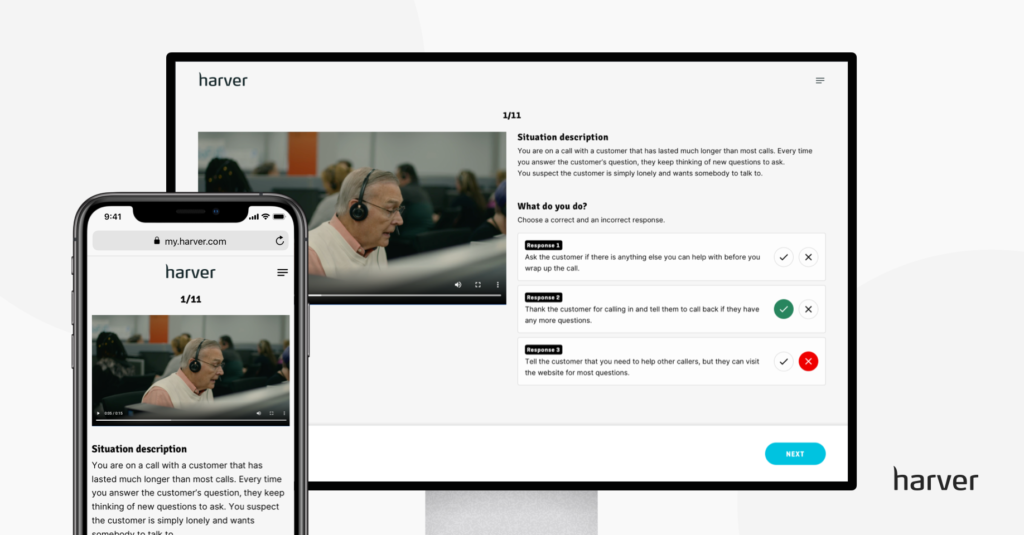
This enables you to filter out the candidates who don't accept the right skills for the job, and at the same time, ensures that in that location'southward no man bias in the choice process, as everything is washed automatically.
Pre-employment assessments can also mensurate inclusivity, ensuring the people you lot bring to your squad are non merely qualified for the chore, simply also welcoming of others. When you're hiring inclusive individuals, information technology tin exist easier to build inclusivity on your squad.
Diversity and inclusion analytics & BI tools
In guild to measure qualitative metrics, you'll want to utilise an analytics or business intelligence platform with a custom dashboard that allows you lot not just to collect the relevant data, but as well to easily visualize it and excerpt actionable insights.
For example, the Harver Diversity and Inclusion solution comes with a dashboard that enables recruiters and Hour leaders to see how their talent conquering programs are performing from a D&I perspective.
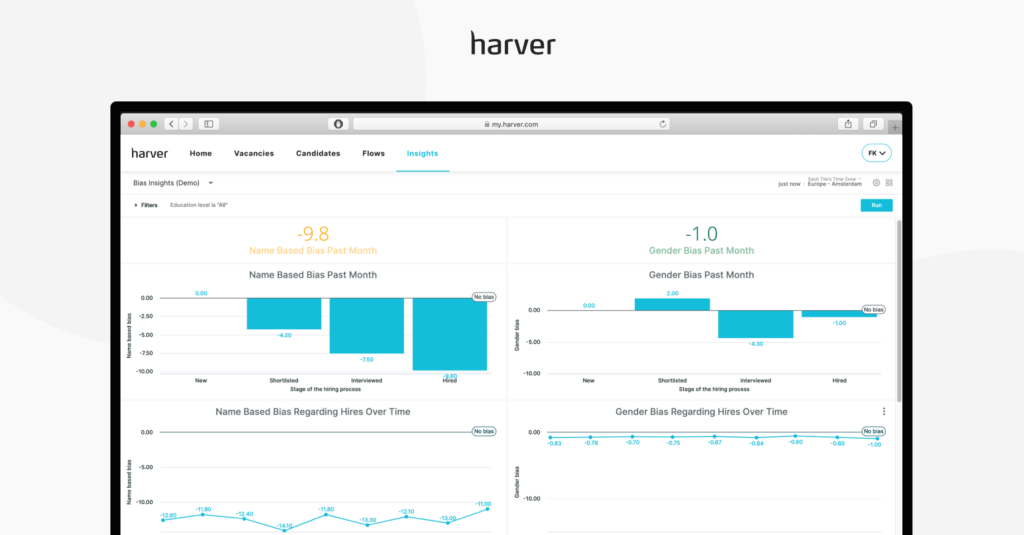
With our tool, companies managing loftier volumes of applicants can easily spot bias in their recruitment process.
Then when you choose an analytics tool for your D&I initiatives, opt for software that allows you to easily run numbers, measure changes, and keep track of how your diversity and inclusion initiatives are working.
Team surveys
Surveys can be one of the all-time means to connect with your team. Through request them to respond to a serial of questions, you can get a better understanding of how they feel about their position, who they work with, and the processes and tools they use every day.
Surveys are likewise like shooting fish in a barrel to customize, making them a great tool for measuring various aspects of inclusion and diversity. Yous can become to know the people working for you better and run ideas past them on how yous can create a more inclusive and welcoming surroundings.
However, employees might be wary near responding to surveys honestly if the survey is not bearding. Brand certain employees feel safe knowing that their responses will not impact their job and will remain anonymous.
Measuring the effectiveness of D&I programs requires quantifiable metrics, but what y'all measure is just as important as how you measure it.
If you'd similar to encounter what our Diversity and Inclusion software tin can practice for you and how it can back up your D&I implementation, get in touch below.
Ready to transform your hiring process?
Source: https://harver.com/blog/diversity-inclusion-metrics/
0 Response to "Hoe Exactly Would You Describe Demographics Asp Art of a Healthcare System?"
Post a Comment